

How Long to Lay Down After Inserting a Suppository: The Doctor’s Guide to Maximum Absorption
What if the most critical factor in your recovery isn't just the medication itself, but the angle of your body? Most patients I speak with feel a sense of urgency to get back to their day, yet they worry that standing up too soon will cause their treatment to leak and lose its efficacy. It's a valid concern because nobody wants to manage a mess while trying to find relief. You're likely asking how long to lay down after inserting suppository treatments to ensure the active ingredients are actually absorbed by your system.
I'm here to tell you that horizontal time is a clinical requirement for biological viability, not just a suggestion. In this guide, I'll provide the exact timing and techniques to ensure your treatment stays in place and works effectively without the mess. You'll learn the physiological reasons why resting for 15 to 20 minutes is the gold standard for maximum absorption and how to build a routine that fits into even the busiest schedule. Let's bridge the gap between clinical necessity and your daily comfort.
Key Takeaways
- Learn exactly how long to lay down after inserting suppository treatments to ensure the carrier melts properly and the active ingredients achieve maximum biological viability.
- Master the Sims Position and other clinical techniques that use gravity to your advantage rather than letting it cause messy leaks.
- Discover how to distinguish between the common "morning leak" of the carrier base and actual medication loss so you can stop worrying about product efficacy.
- Implement the "Bedtime Hack" to seamlessly integrate your health routine into a busy lifestyle while ensuring your body has ample time for full absorption.
- Understand why the delivery system is just as important as the ingredients, especially when trying to keep delicate probiotics alive in a complex internal environment.
The Science of Horizontal Time: How Long to Lay Down?
Let's talk about why you can't just "pop and go." Understanding what is a suppository? is the first step in realizing these are temperature-sensitive delivery systems. These treatments are engineered to be solid at room temperature but transition to a liquid state once they encounter your internal body heat. This biological phase change is essential for the medication to reach the mucosal membranes, but it doesn't happen instantly. When you're wondering how long to lay down after inserting suppository treatments, you're really asking how long it takes for your internal "oven" to liquify the carrier and allow the active ingredients to begin their work.
To better understand this concept, watch this helpful video:
Gravity is the primary enemy of efficacy here. Unlike the rectum, which has a muscular sphincter to help keep things in place, the vaginal canal is more susceptible to "the slip." If you stand up too soon, the partially melted carrier base, whether it's cocoa butter or gelatin, will simply follow the path of least resistance: down and out. This leads to the frustrating "mess" we all want to avoid and, more importantly, it means your medicine ends up on your liner instead of being absorbed by your body.
Why 15 Minutes is the Absolute Minimum
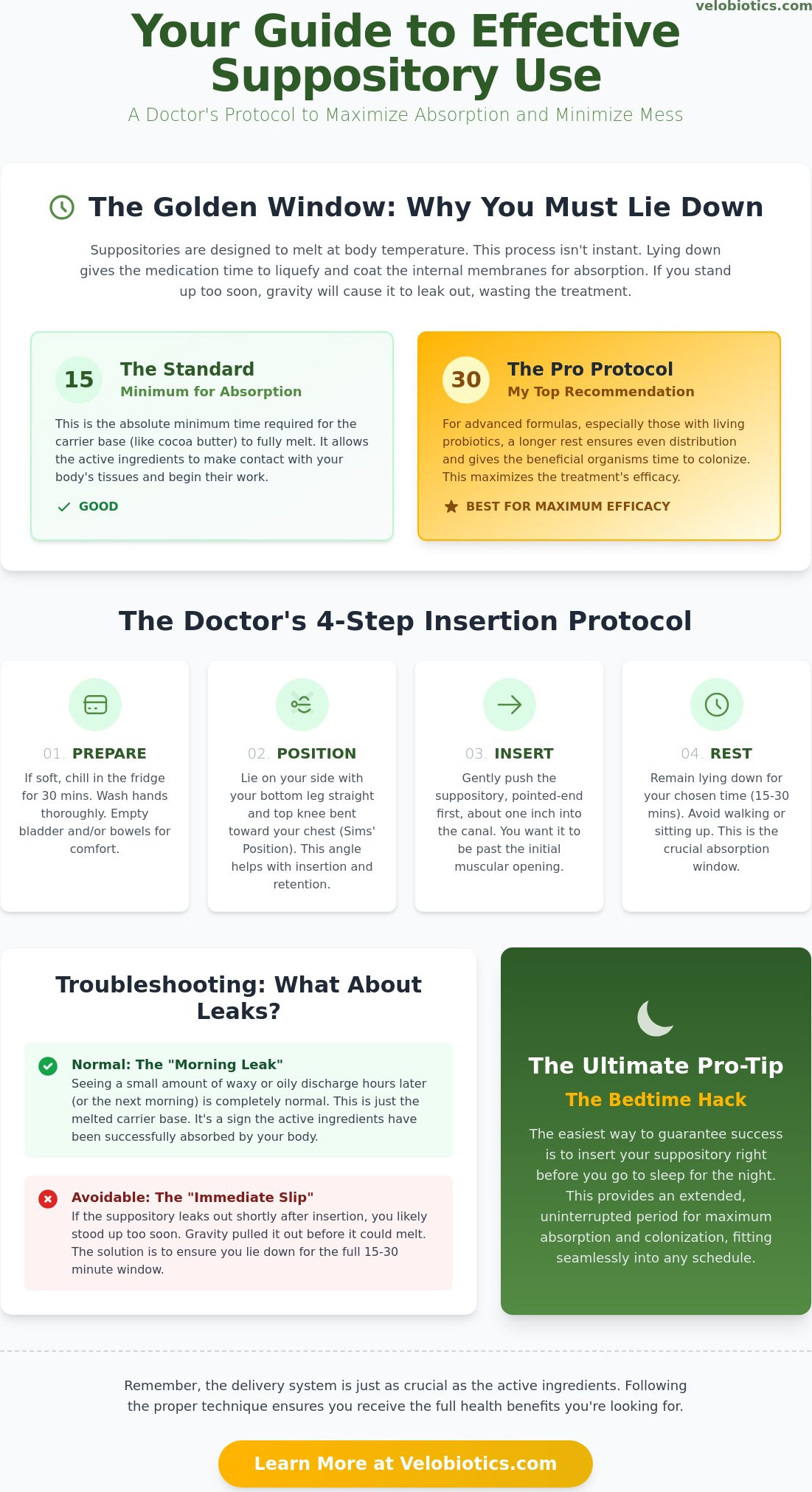
Clinical data suggests that most suppository bases require at least 10 to 15 minutes to fully liquify. During this "Golden Window," the solid mass becomes a fluid coating that covers the sensitive mucosal membranes. If you stand up before this 15-minute mark, you risk losing a significant portion of the active ingredients, such as the boric acid found in Femina Probiotics Cookie Fresh with Boric Acid. Without that quiet time, the biological viability of the treatment drops because the contact time between the medicine and your tissue is cut short.
The 30-Minute "Pro Protocol" for Maximum Efficacy
While 15 minutes gets the job done for simple formulas, I recommend a 30-minute window for high-performance treatments. This is especially true when you're dealing with probiotics. These living organisms need time to disperse and begin colonizing the microbiome. A longer rest period ensures that the formula is distributed evenly across the internal environment rather than pooling at the opening. Horizontal time is the bridge between a messy application and a successful treatment. By giving yourself that extra 15 minutes of rest, you're ensuring the proprietary delivery system has the best possible chance to protect your health.
The Doctor’s Protocol: Step-by-Step for Perfect Insertion
As a physician, I've observed that even the most advanced medical formulas can fail if the delivery technique is flawed. It isn't just about the active ingredients; it's about ensuring those ingredients reach their target tissue and stay there long enough to work. The physical process of insertion is the first step in protecting the biological viability of your treatment. If you don't get the positioning and depth right, you'll find yourself struggling with leakage regardless of how long to lay down after inserting suppository treatments.
Getting Ready: The Pre-Insertion Checklist
Preparation is the foundation of a successful clinical routine. Before you even open the foil, check the firmness of the product. If the suppository feels soft or pliable, it will be difficult to insert and may break apart, leading to an uneven distribution of medicine. I recommend chilling the product in the refrigerator for 30 minutes or running it under cold water while still in the wrapper to restore its structural integrity. This NHS patient guide emphasizes that your environment matters just as much as the product itself.
- Hygiene: Wash your hands thoroughly with soap and water to prevent introducing bacteria into sensitive areas.
- Elimination: Empty your bladder or bowels before you begin. This minimizes the internal pressure that could force the suppository out and ensures you won't need to get up during the absorption window.
- The Recovery Station: Set up your space. Have your phone, a book, or a glass of water within arm's reach so you can remain horizontal without interruption.
The Insertion Process: A Doctor’s Gentle Approach
Positioning is where most people make mistakes. I recommend the Sims Position: lie on your left side with your right knee drawn up toward your chest. This angle aligns with the natural curvature of the internal anatomy, making insertion smoother and more comfortable. If that feels awkward, lying flat on your back with your knees bent toward your stomach also works well. The goal is to relax the pelvic floor muscles. Tensing up is the primary cause of discomfort and can actually trigger a "rejection reflex" where your body tries to expel the suppository immediately.
When you're ready, insert the suppository pointed-end first. Use your index finger or the provided applicator to push it in about one inch. You want it to pass the internal sphincter or the vaginal vestibule to ensure it's securely seated. If you're using a high-quality option like Femina COOKIE FRESH Boric Acid ONLY Suppositories, you'll find that proper depth significantly reduces the "carrier leak" that people often mistake for treatment failure. Once in place, take a few deep, diaphragmatic breaths. This helps settle the pelvic muscles and allows the phase change from solid to liquid to begin undisturbed. Remember, the question of how long to lay down after inserting suppository formulas is only half the battle; the quality of the insertion determines the quality of the relief.
Leakage, Gravity, and "The Slip": Troubleshooting Mishaps
Even when you follow the clinical protocol to the letter, gravity can be a stubborn opponent. I often hear from patients who worry that a single mistake or an untimely sneeze has ruined their entire treatment cycle. The reality is that minor mishaps are common, and knowing how to troubleshoot them is key to maintaining your peace of mind. One of the most frequent questions I get involves the "pee emergency." If you’ve just inserted your treatment and suddenly realize you forgot to empty your bladder, you’re likely calculating exactly how long to lay down after inserting suppository formulas before it’s safe to move. If it's been less than 10 minutes, try to hold it. If you absolutely must get up, move slowly and avoid tensing your abdominal muscles, which can increase internal pressure and force the product out.
The "Immediate Expulsion" Survival Guide
If the suppository slips out within the first minute, don't panic. If the unit is still firm and mostly intact, you can quickly rinse it with cool water and re-insert it immediately. However, if it has already begun the phase change into a liquid or a "mushy" state, discard it. Re-inserting a half-melted product is difficult and often ineffective because the active ingredients are no longer evenly distributed within the carrier. For those who frequently struggle with the "slip," products like Femina Cookie Fresh are specifically engineered for structural stability, making them much easier to handle during those first few critical minutes. If you lose a dose completely after only five minutes, it's usually better to wait until your next scheduled application rather than doubling up, which can lead to localized irritation.
Dealing with Discharge and Mess
Managing the aftermath is where many people feel the most discomfort. You might wake up and see discharge on your sheets or underwear, fearing the treatment was wasted. In most clinical scenarios, this is simply the "carrier"—the fatty base or gelatin—doing its job. Once it melts and releases the active ingredients into your mucosal membranes, the body naturally expels the leftover base. This is a normal byproduct, not a sign of failure.
- Use Protection: A simple panty liner is your best friend during treatment. It manages the discharge without making you feel "soggy" or uncomfortable.
- Distinguish the Leak: If the discharge is oily or clear, it's likely just the carrier. If you see chunks of solid medicine, you probably didn't stay horizontal long enough.
- Safe Cleanup: When cleaning up the next morning, avoid harsh soaps or "feminine washes" that can strip your natural pH. A gentle rinse with warm water is all you need to maintain your biological balance.
Remember, the goal isn't 100% retention of the carrier base; it's the absorption of the active molecules. As long as you’ve followed the guidelines on how long to lay down after inserting suppository treatments, your body has likely harvested what it needs for maximum relief.
Living Your Life: Practical Tips for Daily Integration
Life doesn't pause for medical protocols. As a doctor, I understand that finding a quiet half-hour in the middle of a chaotic Tuesday feels nearly impossible. However, integrating this routine into your life shouldn't be a source of stress. One common question I hear in my practice is whether raising your legs against a wall helps. This is a common myth. While it doesn't hurt, clinical absorption doesn't require acrobatics. Staying flat is sufficient to prevent gravity from causing a leak. When you're calculating how long to lay down after inserting suppository treatments, remember that "horizontal" is the goal, not "inverted."
Why Bedtime is Your Best Friend
Bedtime is the gold standard for a reason. By timing your application right before sleep, you leverage 7 to 8 hours of horizontal time. This extended contact period maximizes the biological viability of the active ingredients, allowing them to interact with mucosal membranes without the interference of movement. You also sleep through the melting and initial absorption phases, which significantly reduces your perception of the "mess." While you're addressing localized issues, don't forget that systemic health matters too. Supporting your microbiome with Velo16 ensures your gut health remains robust while you manage your specific treatment.
Daytime Hacks for the Woman on the Go
If you must use a treatment during the day, strategic timing is essential. Use your lunch break, a long commute where you are reclining, or even a scheduled rest period. If you're on the move, wearing slightly tighter, supportive cotton underwear can provide a bit of external compression to help keep the product seated. While 15 minutes is okay for a quick fix, 30 minutes is the "Doctor’s Choice" for ensuring the formula is fully distributed and absorbed.
Travel requires a bit more planning. If you're staying in a hotel, place an extra towel down to protect the linens and give you peace of mind. On planes, I generally advise waiting until you reach your destination. The cramped quarters and potential for turbulence make it difficult to maintain the necessary quiet time for proper absorption. If you're looking for a solution designed for the modern schedule, you can explore our advanced delivery suppositories to see how we've engineered treatments for maximum efficacy and minimal disruption.
Beyond the Wait: Why Delivery Technology Matters
You've mastered the timing and the positioning. You know exactly how long to lay down after inserting suppository treatments to prevent a mess. But as a doctor, I have to ask: is the medicine you're protecting actually viable? Most people don't realize that the internal environment is incredibly efficient at neutralizing foreign substances. Whether it's the acidity of the stomach or the specific pH balance of the vaginal canal, these biological barriers can kill off delicate probiotics before they ever have a chance to colonize and provide relief. We don't just look at the list of ingredients; we look at the quantifiable survival rate of those ingredients once they enter your body.
The Problem with Standard Suppositories
Standard products often rely on simple cocoa butter or gelatin bases. These carriers melt as expected, but they offer zero protection for the active ingredients. If you're using a probiotic treatment, those "good" bacteria are often dead by the time the carrier liquifies. There's a massive difference between "putting it in" and "it actually working." Efficacy isn't just a marketing term; it's a measure of how many active cultures actually reach the target site alive. We realized early on that industry-wide efficacy gaps were leaving patients frustrated and without the relief they were promised. You can read more about how we decided to bridge the gap between laboratory breakthroughs and your daily routine in The Velobiotics Story.
Innovation in Your Routine
Our approach centers on proprietary micro-encapsulation. Think of it as a microscopic technological seal that protects the probiotics from the internal environment until they are safely seated against the mucosal membranes. While you are resting during that 15 to 30 minute window, this technology is ensuring that the biological viability of the formula remains intact. While you're focusing on how long to lay down after inserting suppository treatments, our micro-shields are busy navigating the complex internal landscape to ensure delivery.
We've also moved beyond the traditional "runny" bases that cause so much discomfort and lead to the discharge issues discussed earlier. By combining the pH-balancing power of Boric Acid with protected probiotics in a single delivery system, we provide a comprehensive solution that stays where it's needed. This synergy allows the Boric Acid to address immediate concerns while the probiotics work to restore long-term balance. Our technology does the heavy lifting so you can focus on your well-being. Explore the Femina Cookie Fresh range for advanced intimate care and experience the difference that clinical-grade delivery makes for your microbiome.
Mastering Your Path to Lasting Relief
Achieving maximum efficacy from your treatment requires more than just high-quality ingredients. It demands clinical precision in your daily routine. You now understand that knowing how long to lay down after inserting suppository treatments is the bridge between a messy application and genuine biological viability. We've covered how the Sims position leverages your anatomy and why the morning leak is usually just the carrier base doing its job. Most importantly, you now know that true relief comes from technology that protects active cultures from harsh internal environments.
As a doctor, I've seen how doctor-founded, clinically backed solutions change lives. Our dual-action Boric Acid and Probiotic formulas use proprietary micro-encapsulation to ensure the good bacteria stay alive long enough to colonize and restore balance. Don't let efficacy gaps stand in the way of your health. Take control of your routine with a system designed to work as hard as you do. Shop Femina Cookie Fresh Probiotic Suppositories and experience the difference of science-led intimate care. You deserve a routine that's as effective as it is effortless.
Frequently Asked Questions
Can I pee after inserting a suppository?
You can physically urinate, but it's best to wait at least 15 minutes. While the urethra and vaginal canal are separate, the muscular strain of urinating can shift the suppository or force it out before it melts. I always suggest emptying your bladder before you begin the insertion process. If it's an emergency, move slowly and try to avoid tensing your pelvic floor muscles.
What if I forget to lie down after inserting the suppository?
If you stay upright, gravity will likely pull the treatment toward the vaginal opening before it can fully disperse. This reduces the contact time with your mucosal membranes and compromises the biological viability of the active ingredients. You don't necessarily need to re-insert a new one, but you might notice more leakage than usual. Just make sure to follow the protocol for your next dose.
Is it okay to use a tampon with a suppository?
You should avoid tampons while using these treatments. Tampons are engineered to absorb fluids, which means they'll soak up the medication before your body has a chance to utilize it. This effectively wastes the product. Use a panty liner or a pad instead to manage any discharge from the carrier base. This ensures the medicine stays in direct contact with your internal tissue for maximum relief.
How deep should a vaginal suppository go?
Aim to insert the suppository about one inch into the canal. This is roughly the length of your index finger up to the second knuckle. You want the product to sit past the vaginal vestibule so the internal walls can hold it securely in place. Don't worry about it getting lost; the anatomy doesn't allow for that. Proper depth is essential for preventing the product from slipping out prematurely.
Why does my suppository leak the next morning?
Next-morning leakage is typically just the carrier base exiting your system. Once the active ingredients are absorbed into your tissue, your body naturally expels the leftover cocoa butter or gelatin. It's a normal byproduct of the process. Since you've already followed the guidelines for how long to lay down after inserting suppository treatments, you can be confident that the medicine has already done its work.
Can I use a suppository during my period?
You can use a suppository during your period, but be aware that a heavy flow might wash away some of the medication. If your symptoms are bothersome, continue the treatment as scheduled. You'll need to use pads rather than tampons during this time to avoid absorbing the medicine. The extra moisture might cause the carrier to melt faster, so stay diligent about your quiet time after insertion.
How long does it take for a suppository to fully dissolve?
Most suppositories begin to liquify within 10 to 15 minutes, but it can take 30 to 60 minutes to fully dissolve into a fluid state. Full absorption of the active molecules into your system occurs over several hours. This is why I recommend the 30-minute rest period. It ensures the phase change from solid to liquid is complete before you return to your normal physical activities.
What happens if I stand up too soon?
Standing up too soon usually results in "the slip," where the melting carrier leaks out due to gravity. This is the primary reason patients ask how long to lay down after inserting suppository formulas. When the product leaks out prematurely, you lose a portion of the active ingredients, which reduces the overall potency of the treatment. You'll also likely deal with a messy cleanup that could have been avoided.

Disclaimer
Information and statements regarding dietary supplements/products have not been evaluated by the Food and Drug Administration, MCC/SAHPRA, MHRA, TGA or any other drug regulatory authority and are not intended to diagnose, treat, cure, or prevent any disease. Information on this website is provided for informational purposes only and is a result of years of practice and experience by the author. This information is not intended as a substitute for the advice provided by your physician or other healthcare professional or any information contained on or in any product label or packaging. Do not use the information on this website for diagnosing or treating a health problem or disease, or prescribing medication or other treatment. Always speak with your physician or other healthcare professional before taking any medication or nutritional, herbal, or homeopathic supplement, or using any treatment for a health problem. If you have or suspect that you have a medical problem, contact your healthcare provider promptly. Do not disregard professional medical advice or delay in seeking professional advice because of something you have read on this website.