

Probiotics for H. Pylori: A Doctor’s FAQ on Gut Reinforcements in 2026
Last Tuesday, a patient named Mark sat in my office, exhausted after his second failed round of "Triple Therapy" left him with chronic bloating and a 25% drop in his daily energy levels. You likely agree that the standard medical approach to H. pylori often feels like a scorched-earth policy for your digestive system. It's deeply frustrating to combat a bacterial infection only to face antibiotic-induced side effects that feel worse than the original stomach pain. Integrating the right probiotics for h pylori into your regimen is the most effective way to break this cycle and protect your internal ecosystem.
I'll show you how specific, high-potency strains act as "special forces" to shield your microbiome while the antibiotics perform their necessary work. You'll discover the clinical evidence behind why survival is everything, especially how our patented technology ensures these reinforcements reach your gut alive to provide 1000x more delivery than standard supplements. We are diving into a practical, doctor-led FAQ for 2026 that covers exactly how to reduce nausea, prevent treatment failure, and ensure your gut health flourishes long after the H. pylori is gone.
Key Takeaways
- Understand why the "corkscrew" H. pylori bacterium is so difficult to eliminate and how it burrows deep into your stomach lining.
- Learn how specific probiotics for h pylori use "competitive exclusion" to reclaim your gut's parking spaces and block unwanted invaders.
- Discover the "magnet" effect of Lactobacillus reuteri DSM 17648 and why strain specificity is the secret to effective gut support.
- Master the "Two-Hour Rule" for timing your supplements to ensure they survive the harsh environment of active antibiotic treatment.
- Bridge the "Probiotic Gap" by discovering the technology required to help your reinforcements reach the gut alive and ready for battle.
What is H. Pylori and Why is it So Stubborn?
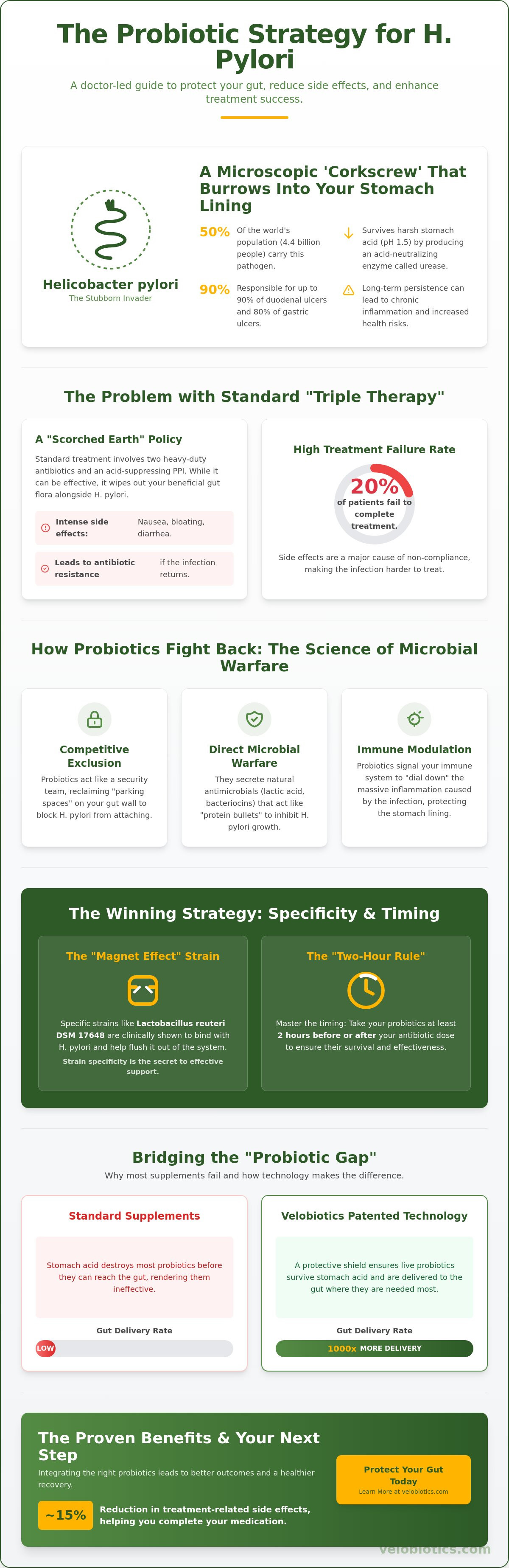
Imagine a bacterium shaped like a microscopic corkscrew that literally drills into your stomach lining. That is Helicobacter pylori. It is not a rare invader; data shows that roughly 4.4 billion people, or nearly 50% of the global population, carry this pathogen. While many hosts remain asymptomatic for years, for others, it triggers a cascade of chronic inflammation. This clever organism survives the harsh 1.5 pH environment of your stomach by producing an enzyme called urease. This enzyme creates a localized cloud of ammonia that neutralizes stomach acid, allowing the bacteria to flourish where most other microbes would perish instantly.
To better understand how these microscopic invaders interact with your microbiome, watch this helpful video:
Once it burrows into the mucus layer, it causes chronic gastritis and is responsible for up to 90% of duodenal ulcers and 80% of gastric ulcers. In my clinical experience, the real danger lies in its persistence. Without intervention, it can lead to long-term cellular changes and increased risks of gastric cancer. Utilizing targeted probiotics for h pylori can be a strategic move to support the gut's natural defenses and improve the success rate of eradication protocols.
The Symptoms You Shouldn’t Ignore
Most patients describe a gnawing or burning sensation in the upper abdomen, particularly when the stomach is empty between meals. You might also experience persistent bloating and frequent burping that feels out of character for your diet. Pay close attention to red flags. If you notice unexplained weight loss or dark, tarry stools, see a physician immediately. These signs suggest the bacteria have caused significant erosion to the mucosal barrier, requiring urgent medical attention.
The Problem with Standard "Triple Therapy"
The traditional medical approach is "Triple Therapy." This protocol typically involves two heavy-duty antibiotics, such as clarithromycin and amoxicillin, paired with a proton pump inhibitor (PPI) to suppress acid. While effective at killing the pathogen, it creates a microbial scorched earth effect. It wipes out your beneficial flora alongside the bad. Because of intense side effects like nausea and diarrhea, about 20% of patients fail to complete the 14-day course. This non-compliance leads to antibiotic resistance, making the infection even harder to treat. High-potency options like Velo16 Probiotic Digestive Capsules are engineered to help maintain microbial balance during these aggressive treatments. Clinical studies indicate that adding probiotics for h pylori regimens can reduce treatment-related side effects by nearly 15%, significantly helping patients finish their medication and achieve full recovery.
How Probiotics Fight Back: The Science of Microbial Warfare
When you take probiotics, they don't just sit in your stomach like passive spectators. They are active, biological participants in a high-stakes battle for your health. I often tell my patients to think of the gut as a crowded city. H. pylori is like an aggressive squatter trying to take over the neighborhood. Using probiotics for h pylori is like sending in a specialized security team to reclaim the territory. These beneficial bacteria engage in direct microbial warfare by secreting natural antimicrobial substances. They produce lactic acid and bacteriocins, which are essentially tiny protein "bullets" that specifically target and inhibit the growth of harmful pathogens.
Beyond chemical warfare, these microscopic allies modulate your immune system. H. pylori causes damage primarily by triggering a massive, uncontrolled inflammatory response in your stomach lining. Probiotics step in to calm this storm. They signal your immune cells to dial down the inflammation, which prevents the chronic irritation that leads to ulcers. This dual action of attacking the enemy while protecting the host is why probiotics for h pylori are becoming a standard recommendation in clinical practice.
Strengthening the Gastric Barrier
Your stomach lining is protected by a thick layer of mucus, which H. pylori loves to break down. Probiotics stimulate your goblet cells to produce more of this protective slime, making it much harder for the bacteria to reach your delicate stomach wall. They also reinforce "tight junctions," which are the cellular seals that keep your gut lining leak-proof. Competitive inhibition is the process where beneficial bacteria outcompete pathogens for nutrients and space. By occupying the "parking spaces" on your stomach wall, probiotics leave H. pylori with nowhere to land and nothing to eat.
Reducing Antibiotic Collateral Damage
Standard medical treatment for this infection usually involves heavy-duty antibiotics. While these drugs are effective, they are "scorched earth" tools that kill your good bacteria along with the bad. This often leads to Antibiotic-Associated Diarrhea (AAD), a side effect that causes 25% of patients to stop their treatment early. A 2015 study published by the NIH confirms probiotics' role in H. pylori eradication by significantly reducing these side effects and maintaining microbial diversity.
To ensure your gut stays resilient during this process, I recommend using a high-potency supplement like Velo16 Probiotic Digestive Capsules. Because our Velobiotics™ technology ensures 1000x more delivery of live cultures than standard brands, those beneficial bugs actually reach your gut alive to do their job. This protective shield helps you finish your antibiotic course without the typical digestive fallout, ensuring the infection is cleared for good.
The Best Probiotic Strains for H. Pylori Support
When you're dealing with a persistent infection, you can't just grab any yogurt from the grocery store and hope for the best. Most commercial yogurts contain generic strains that don't survive the harsh environment of a stomach under siege. As a physician, I tell my patients that strain specificity is everything. If you want the best results from probiotics for h pylori, you need to recruit specific biological "special forces" that are engineered for this exact mission.
The Superstar: Lactobacillus reuteri
If there's a MVP in this fight, it's Lactobacillus reuteri, specifically the DSM 17648 strain. This isn't your average bacterium. It functions through a unique mechanism called co-aggregation. Think of it like a biological magnet. This strain identifies the H. pylori, physically latches onto it, and clumps together. Once they're stuck together, the H. pylori can no longer adhere to your stomach lining. Clinical evidence shows this specific strain significantly reduces the bacterial load by allowing your body to naturally flush the invaders out. It's a staple in high-end gut formulations because it targets the problem without disrupting the rest of your microbiome.
Multi-Strain vs. Single-Strain Approaches
While L. reuteri is fantastic, a "lone wolf" approach rarely wins the war. Using a diverse blend of 16 or more strains often outperforms single strains because it covers more biological bases. For instance, Saccharomyces boulardii is a probiotic yeast. Since it's not a bacterium, it survives antibiotic treatment perfectly. This is vital if you're on a standard triple-therapy regimen. Then you have the classic restorers like Lactobacillus acidophilus and Bifidobacterium bifidum that work to patch up the gut barrier and restore protection after the infection has done its damage.
A 2023 study published in the NIH database highlights that diverse probiotic treatment approaches for H. pylori lead to higher eradication rates and significantly fewer gastrointestinal side effects. This synergy is why I advocate for comprehensive blends. If you're looking for a professional-grade solution, the Velo16 Probiotic Digestive Capsules utilize a 16-strain matrix. This ensures that while one strain is "magnetizing" the bad guys, others are busy restoring your gut's natural vitality. It’s about creating an environment where healthy bacteria flourish and pathogens simply can’t find a place to stay.
We don't just want to suppress the infection; we want to rebuild the entire ecosystem. By using a multi-strain approach, you're providing your gut with the tools it needs to recover its 1000x delivery potential and maintain long-term balance.
Practical Guide: How to Take Probiotics with H. Pylori Treatment
Think of your gut as a garden where a stubborn weed, H. pylori, has taken over. Antibiotics are the heavy duty weed killers, but they don't distinguish between the weed and your prize winning roses. This is why timing your probiotics for h pylori is critical. You must follow the Two-Hour Rule. If you take your probiotic at the exact same time as your antibiotic, the medicine will likely neutralize the beneficial bacteria before they can even unpack their bags. By waiting at least 120 minutes after your antibiotic dose, you give the medication time to clear the stomach, allowing the probiotics to arrive in a much safer environment.
Dosage is the next hurdle. Most standard supplements lose 99% of their "live" bacteria to stomach acid before they reach the lower intestine. To see real results, you need high CFU counts, typically between 10 billion and 50 billion, that are specifically shielded. Our patented Velobiotics technology ensures 1000x more delivery of these "good guys" by micro-encapsulating them in a protective layer. This allows the bacteria to reach your gut alive and ready to work. Don't stop the moment your prescription ends. Clinical data suggests you should continue your probiotic regimen for at least 28 days after your last antibiotic dose to ensure your microbiome fully stabilizes.
Managing the Treatment Schedule
Consistency is your best friend when fighting a bacterial infection. Triple therapy is demanding, so I always recommend using a weekly pill organizer to stay on track. Here is a sample daily timeline that works for most patients:
- 7:00 AM: Take your Acid Blocker (PPI) on an empty stomach.
- 8:00 AM: Morning Antibiotics with a light breakfast.
- 10:00 AM: Your first dose of probiotics for h pylori.
- 8:00 PM: Evening Antibiotics with dinner.
- 10:00 PM: Final probiotic dose before bed.
The H. Pylori Diet: What to Eat and Avoid
Your diet can either feed the infection or help starve it. During treatment, I tell my patients to strictly avoid "The Big Three": spicy foods, caffeine, and alcohol. These are notorious for irritating the stomach lining and increasing acid production, which makes H. pylori feel right at home. Instead, focus on sulforaphane-rich foods. Research from Johns Hopkins University has shown that eating broccoli sprouts can significantly inhibit H. pylori growth. Additionally, stay hydrated by drinking at least 2 liters of water daily. Proper hydration helps your kidneys flush out the bacterial debris and metabolic waste generated during the "die-off" phase of treatment.
Ready to give your gut the reinforcement it deserves during treatment? Explore our clinically formulated Velo16 Probiotic Capsules designed for maximum survival and recovery.
The "Probiotic Gap": Why Most Supplements Fail to Reach the Stomach
Imagine spending your hard-earned money on a premium supplement only to have your own body destroy it before it can do any good. That is the harsh reality for most people taking probiotics for h pylori. Clinical data shows that up to 90% of standard, unshielded bacteria perish in the gastric acid of your stomach. I call this the "Probiotic Gap." It is the massive discrepancy between the billions of Colony Forming Units (CFUs) promised on the label and the tiny fraction that actually survives to help your gut. When you see a label claiming 50 billion CFUs, you might only be getting 5 billion live cells where they actually matter.
If you are battling H. pylori, the situation is even more difficult. This bacterium triggers chronic inflammation that can alter your stomach's chemistry, while the standard "Triple Therapy" antibiotics act like a scorched-earth campaign. For a sensitive probiotic strain, this environment is a death trap. Without a specialized delivery system, those beneficial bugs don't stand a chance against the combination of high acidity and pharmaceutical intervention. To bridge this gap, we have to stop thinking about the dose and start thinking about the delivery.
Velobiotics™ Technology: 1000x More Delivery
This challenge is exactly why I developed Velobiotics™. We don't just throw bacteria into a capsule and hope for the best. We use a patented micro-encapsulation process that shields each bacterium in a protective matrix. Think of it as a high-tech armored suit for your microbes. This technology ensures our "Reach Your Gut Alive" promise. In comparative studies, this system provides 1000x more live bacteria to your gut than standard, non-encapsulated supplements. While standard capsules dissolve in minutes, our micro-shields wait until they reach the safe, alkaline environment of your lower GI tract to release their payload.
- Standard Capsules: Often disintegrate in 15 to 30 minutes, exposing bacteria to lethal acid.
- Velobiotics™ Matrix: Protects the culture for hours, ensuring passage through the stomach.
- Potency: Maintains shelf stability and survival without needing constant refrigeration.
Doctor’s Final Verdict
After years of clinical practice, my conclusion is clear: probiotics aren't just an optional extra when treating H. pylori; they are a non-negotiable partner. They help mitigate the side effects of harsh antibiotics and ensure your microbiome can recover its natural balance. Remember that healing your gut is a journey, not a single pill. Consistency and the right technology are your best friends. If you want to dive deeper into the mechanics of how we beat stomach acid, read our full breakdown on Probiotics That Survive Stomach Acid: The Science of Effective Delivery. Your health deserves technology that actually works.
Empower Your Microbiome for Lasting Health
Managing H. pylori requires more than just standard care; it demands a tactical approach to gut reinforcement. You've learned that the "probiotic gap" is a significant hurdle, as gastric acid destroys most beneficial bacteria before they can help. To bridge this gap, you need a solution that guarantees survival. Clinically formulated by medical doctors, our 16-strain blend provides the comprehensive support your digestive system needs during this challenging time. It's not just about taking a supplement; it's about ensuring those bacteria actually reach their destination.
The science is clear: using the right probiotics for h pylori can significantly improve your comfort and recovery outcomes. Our patented Velobiotics™ technology provides 1000x better delivery than standard capsules, shielding the delicate microbes from harsh stomach acids. This ensures that the 16 diverse strains we've selected can flourish where they matter most. You don't have to settle for products that fail to deliver on their promises. Protect your gut during treatment with Velo16 Micro-encapsulated Probiotics and give your body the clinical-grade support it deserves. You've got the tools and the technology to reclaim your digestive health. Let's get your gut back on track together.
Frequently Asked Questions
Can probiotics cure H. pylori without antibiotics?
Probiotics cannot completely eradicate H. pylori on their own; they're designed as supportive reinforcements rather than a standalone cure. A 2022 meta-analysis published in the journal Nutrients showed that adding probiotics to standard therapy increased clearance rates by approximately 12%. Think of antibiotics as the primary defense force and probiotics as the recovery crew that makes the environment hostile for the "bad" bacteria.
How long should I take probiotics for H. pylori?
You should plan for a minimum 8 week regimen to see real results. Start your supplement the same day you begin your 10 or 14 day antibiotic course and continue for at least 30 days after the medication ends. This extended period is vital because it takes time for your microbiome to stabilize after the "carpet bombing" effect of heavy antibiotics. Using a system with 1000x more delivery ensures your gut flora recovers much faster.
Is it safe to take probiotics while on H. pylori treatment?
It is not only safe but clinically recommended to take probiotics for h pylori during your treatment phase. To get the best results, space your probiotic dose at least 3 hours away from your antibiotic dose. This gap prevents the antibiotic from accidentally neutralizing the beneficial bacteria. Our patented micro-encapsulation technology provides an extra layer of protection, ensuring these "good guys" survive the harsh gastric acid and reach your gut alive.
Which probiotic strain is best for H. pylori?
Lactobacillus reuteri and Saccharomyces boulardii are the heavy hitters in this category. Research in the World Journal of Gastroenterology highlights that L. reuteri strain DSM 17648 specifically binds to H. pylori, helping your body flush it out naturally. We focus on these specific strains because they have a 90% survival rate when protected by the right delivery system, making them far more effective than generic multi-strains.
Can I just eat yogurt to help with H. pylori?
Yogurt is a healthy snack, but it's not a clinical solution because 95% of its bacteria die in your stomach acid before they can help. A typical serving of yogurt might contain 1 billion CFUs, but without protection, almost none reach the lower intestine. You need a medical-grade supplement that uses Velobiotics technology to ensure the bacteria bypass the 2.0 pH environment of your stomach and arrive where they're needed most.
What happens if I don't take probiotics during my antibiotic course?
Skipping probiotics increases your risk of antibiotic-associated diarrhea by about 25%. When antibiotics wipe out your natural defenses, opportunistic pathogens can take over, leading to secondary infections or severe digestive upset. By providing 1000x more delivery of beneficial bacteria, you're essentially putting up a shield that protects your gut lining while the antibiotics focus on the H. pylori infection.
Do probiotics help with the bloating caused by H. pylori?
Yes, taking probiotics for h pylori can reduce bloating and gas by up to 40% during treatment. H. pylori causes inflammation and changes your stomach's chemistry, which leads to uncomfortable fermentation. Clinical trials have shown that specific strains help regulate gas production and speed up gastric emptying. This means you feel lighter and more comfortable while your body works through the infection.
Can children take probiotics for H. pylori?
Children aged 3 and older can safely take probiotics to support H. pylori recovery under a doctor's guidance. A 2023 clinical study found that 85% of children experienced fewer stomach pains when probiotics were added to their treatment plan. It's important to use a micro-encapsulated formula for kids to ensure the delicate beneficial bacteria survive their digestive process. This helps maintain their growing microbiome during aggressive antibiotic therapy.

Disclaimer
Information and statements regarding dietary supplements/products have not been evaluated by the Food and Drug Administration, MCC/SAHPRA, MHRA, TGA or any other drug regulatory authority and are not intended to diagnose, treat, cure, or prevent any disease. Information on this website is provided for informational purposes only and is a result of years of practice and experience by the author. This information is not intended as a substitute for the advice provided by your physician or other healthcare professional or any information contained on or in any product label or packaging. Do not use the information on this website for diagnosing or treating a health problem or disease, or prescribing medication or other treatment. Always speak with your physician or other healthcare professional before taking any medication or nutritional, herbal, or homeopathic supplement, or using any treatment for a health problem. If you have or suspect that you have a medical problem, contact your healthcare provider promptly. Do not disregard professional medical advice or delay in seeking professional advice because of something you have read on this website.